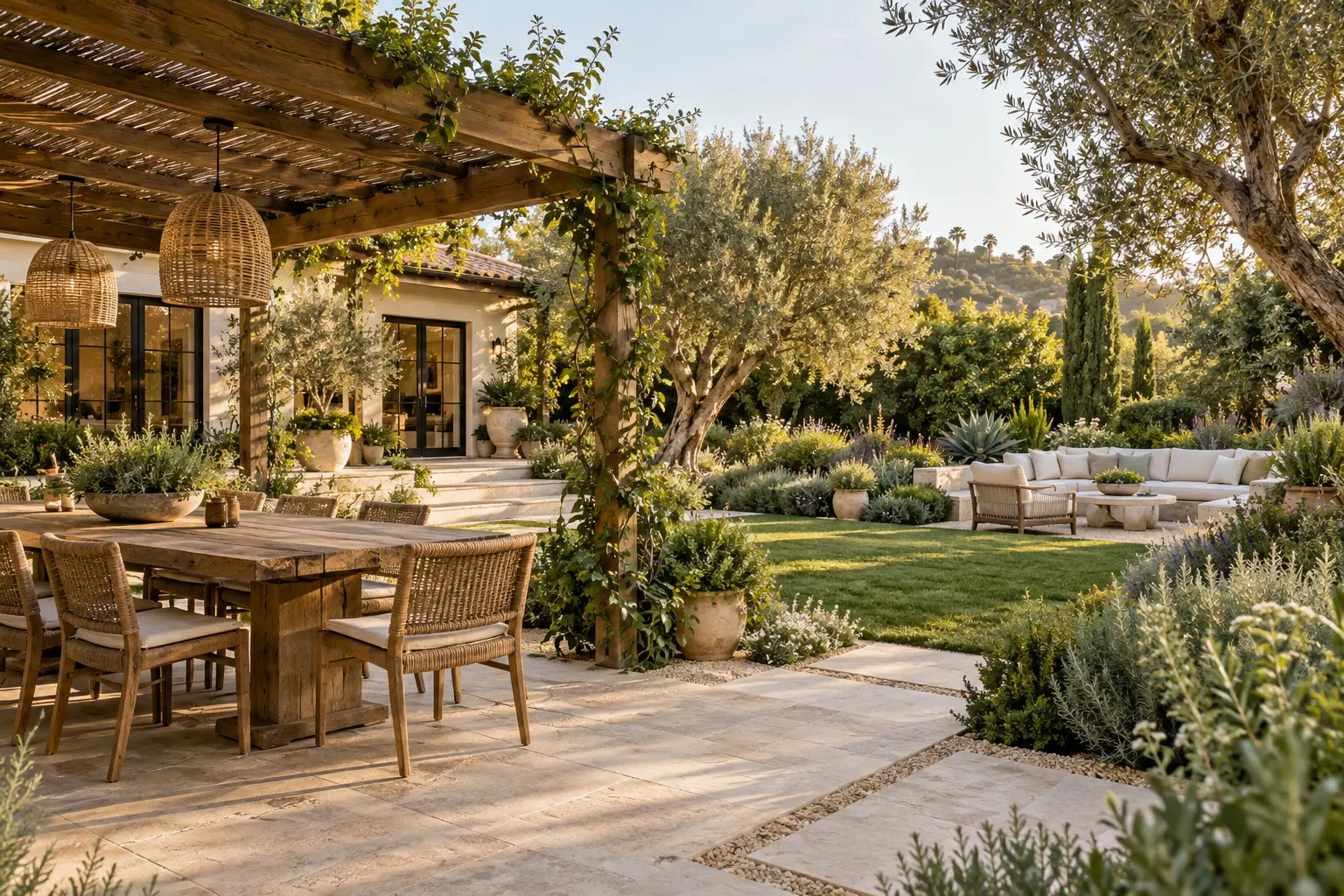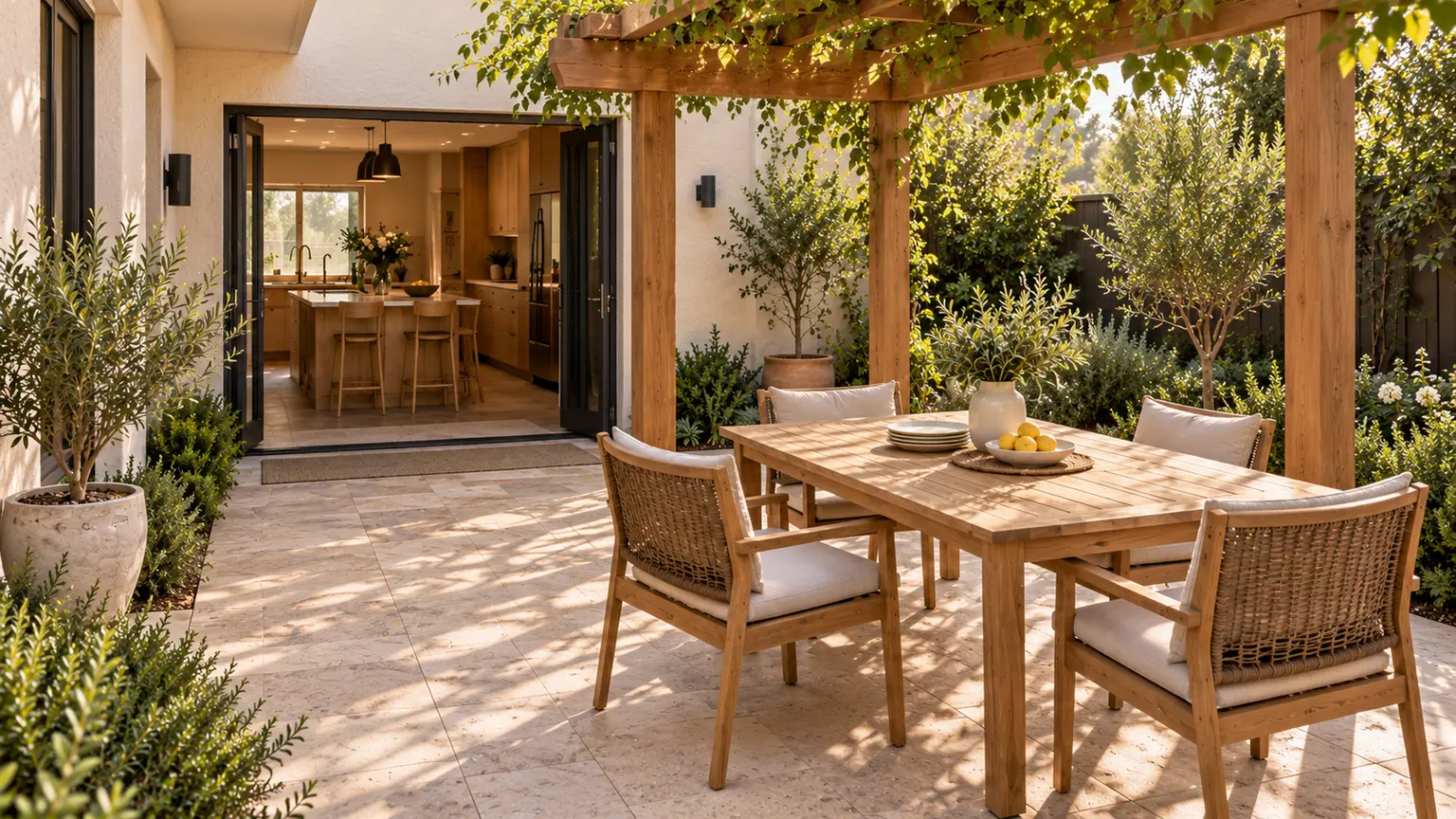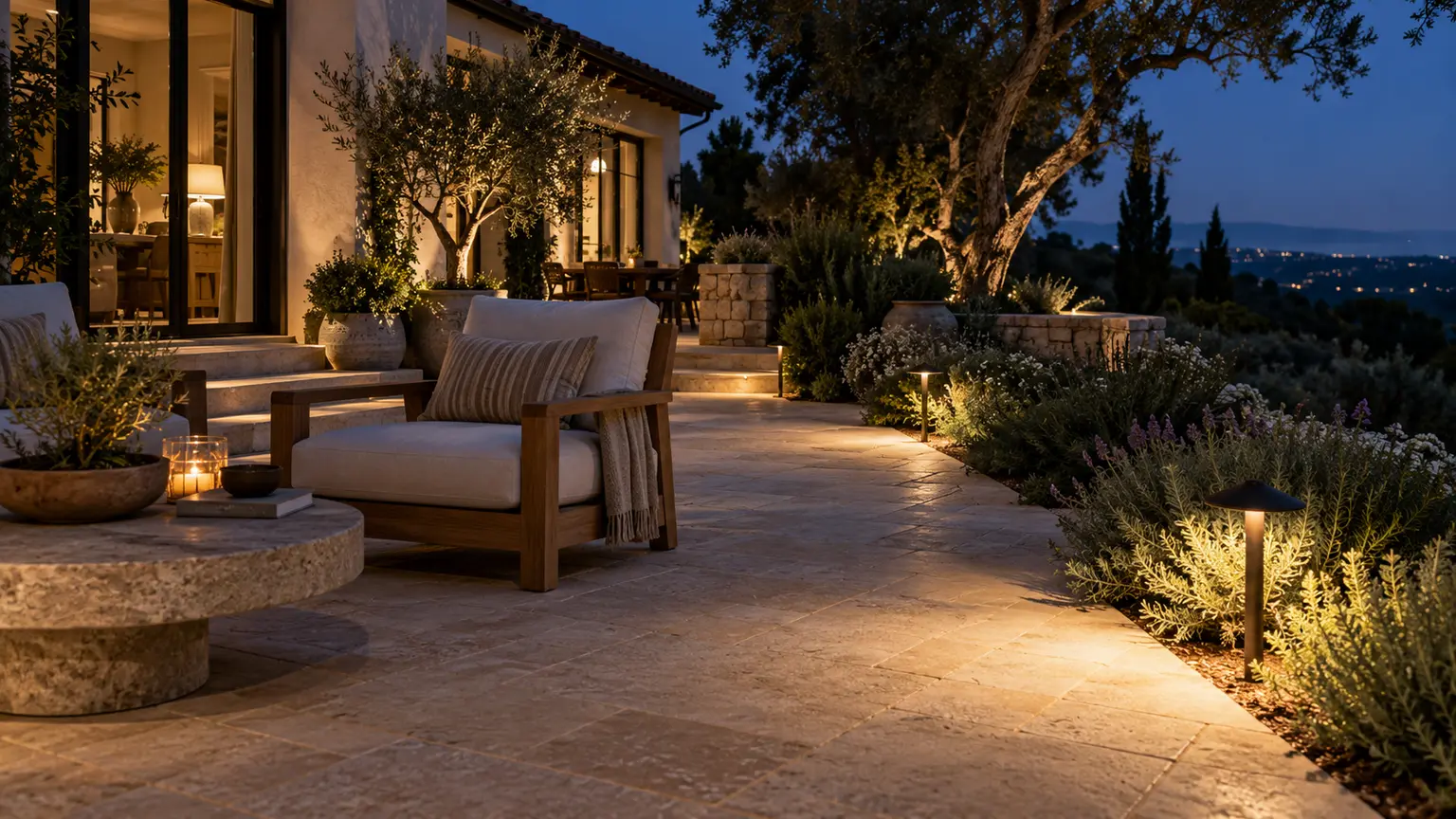
The new lights make the garden visible. From the sofa, you can see the bulbs even better.
That is a different problem from a patio that is too dark. Adding another light, or choosing a warmer bulb, may leave the bright source in exactly the same place in your view.
Before ordering a full set of fixtures, ask for a nighttime sample review. Look at what the light reaches, then look back toward the light from the places you actually use. A good lighting plan has to account for both.
A planning guide, not a measured lighting design, installation specification or safety assessment.
Watch the story
Loading the film connects to YouTube. Google’s privacy policy applies.
Separate the thing you want to see from the light you can see
Imagine a terrace with a garden path beside it. A small fixture lights the paving. From the back door, the effect looks appealing. From the lounge chair, the exposed source sits almost directly in your view.
The path and the chair are asking two different questions. Is the walking surface adequately lit? Is the light uncomfortable to look toward from the seat? A fixture can address the first and still need work on the second.
Glare is not determined by a single number on a box. The Department of Energy's glare research overview describes work examining source position, size, light distribution, surrounding brightness and spectrum. For a homeowner, the useful implication is simple: inspect the actual view, not just the stated output.
Make a small sketch with two marks: the surface to illuminate and the place you will look from. If those are treated as the same thing, the fixture selection is getting ahead of the design.
Planning reference: glare research overview.
Ask to see the shielding, not just the finish
A bronze finish can suit the garden beautifully. It does not tell you whether the bulb or LED will be exposed from the chair.
Ask the lighting professional to show how the proposed fixture directs light and screens the source from the relevant viewpoints. The National Park Service's outdoor lighting guidance describes recessed, shielded sources that direct light toward the task rather than leaving the source visible at eye level. That is a useful design principle, not a residential installation specification.
In our terrace example, the sample review might compare a different shield, a revised aim or a different position. Change one variable at a time. Keep checking the path as well as the chair, so hiding the source does not quietly remove the light needed on the ground.
A downward-pointing fixture is not automatically hidden from every nearby viewpoint. Ask to see the actual arrangement from the side as well as underneath it. Accessories, compatibility and installation belong with the selected product and qualified installer. Do not tape over, paint or improvise a cover for a light.
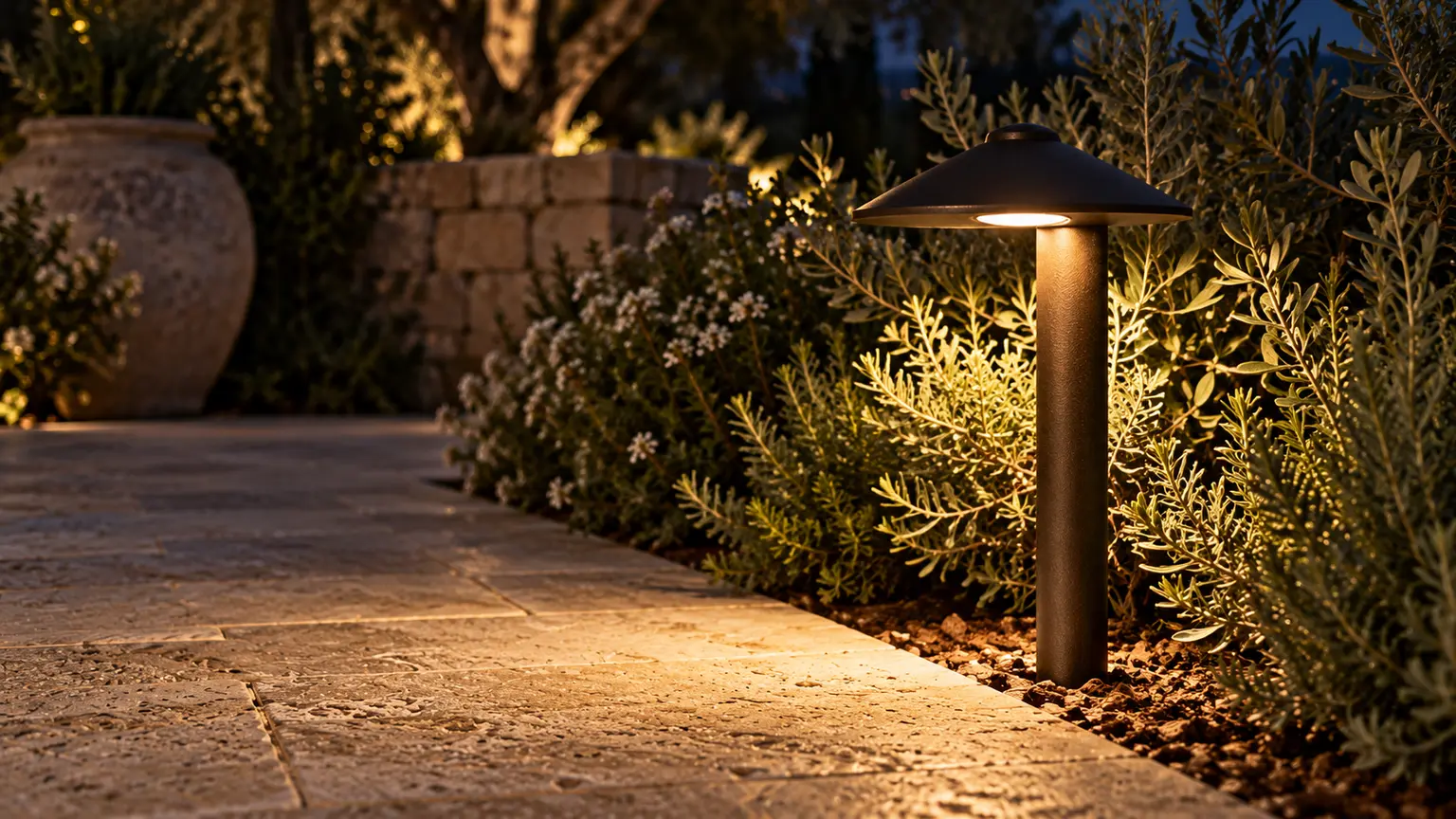
Planning reference: outdoor lighting guidance.
Warm is a color, not a dimmer
Two specifications deserve separate lines in your notes. The Department of Energy distinguishes color appearance, described by correlated color temperature in kelvins, from light output, measured in lumens. A warm-looking source can still be too bright or poorly aimed for the view you want.
DarkSky's home-lighting guidance recommends warmer-color lighting and treats shielding, output and controls as separate checks. Do the same when reviewing a product. Do not let the word "warm" stand in for every other decision.
Ask to see the proposed color and output together on your paving, planting and table. Then ask what dimming is actually supported by that fixture and its controls. A beautiful low-output demonstration is not useful if the installed arrangement cannot reproduce it.
There is no universal lumen count in this guide. The relevant surfaces, positions, tasks and product distribution need to be assessed together. Nor does a photograph establish how comfortable a real light will feel.
Planning reference: Department of Energy: purchasing energy-efficient light bulbs.
Planning reference: DarkSky's home-lighting guidance.
Review the scene after dark, from more than the doorway
Arrange the sample with the installer using equipment suited to the location. Keep existing necessary lighting available; this is not a reason to explore an unlit route or work on wiring yourself.
Start with one troublesome or important area rather than buying the whole garden's fixtures at once. For our terrace, that is the path beside the lounge seat. Use this review card:
| Check | What to record |
|---|---|
| Target | What needs to be visible: the path surface, a step, the table or another specific task |
| View | What the source looks like from the normal seat, approach and doorway |
| Spill | Whether light reaches a window or beyond the intended area, observed from places you may lawfully access |
| Change | The one adjustment being compared, such as aiming, shielding, position or output |
| Result | What improved, what became harder to see, and what still needs the professional's assessment |
Describe an observation rather than jumping to a purchase. "The source is in my view from the left seat" is more useful than "we need dimmer lights." So is "the planting is bright, but the path edge is still difficult to make out."
Include the view from inside the house if you enjoy looking into the garden at night. If there is a spill concern near a neighbor, identify it without entering their property or assuming what their room looks like. Ask the installer to address it as part of the design.
Decide what stays on after dinner
The table, the route back to the door and a decorative garden feature do not necessarily need the same operating hours. Discuss which uses should be controlled separately, rather than accepting one all-on scene as the only option.
DarkSky and the Illuminating Engineering Society's five outdoor-lighting principles call for purposeful, targeted light at an appropriate level, used when needed, with warmer color where possible. Translate that into a question about your evening: which lights are useful while you sit outside, and which are needed when you leave?
Ask how the proposed timer, sensor or dimming arrangement behaves in practice. What switches on? What remains on? Can you operate it without opening an app every time? Keep any required lighting and applicable local requirements in the professional's scope. This article is not an electrical design, safety certification or reason to switch off necessary lighting.
Planning reference: five outdoor-lighting principles.
A request worth sending before you order
"Please demonstrate the proposed light after dark at the intended location. We want to review the lit surface, source visibility from our seating and approach, spill toward nearby windows and boundaries, and the proposed controls. Show which changes are possible with this fixture, and confirm the installation requirements before we order the full set."
Our example began with a visible path and a bulb dominating the seated view. The goal is not simply less light. It is useful light in the right place, without making the fixture the main thing you notice.
If you have not yet decided which parts of the yard deserve attention, start with the ordinary-evening backyard guide. Once the uses are clear, review the lighting from where those uses happen.
 A little inspiration to take home.