You love the quiet little piece of oak on the kitchen counter. But are you choosing that piece, or a room full of boards that will not all look like it?
That is the gap to close before ordering a wood floor. Check the exact product in your home's light, ask to see its expected range of boards, and arrange to inspect the delivered material before installation. Those are three different checks. Passing one does not settle the others.
This guide is about the appearance of prefinished real-wood flooring, including engineered wood. It is not a comparison of wood, vinyl and tile, or a substitute for checking whether a product suits your rooms and installation.
Appearance checks to discuss with your flooring supplier and installer.
Watch the story
Loading the film connects to YouTube. Google’s privacy policy applies.
The board you like may be the quietest one
Imagine choosing a pale floor for a living room with oak cabinetry that will stay. The small sample has fine grain and hardly any dark marks. You like the color, but you also like how little it asks you to notice.
Then you see a larger spread of the product. There are darker boards, stronger grain and visible knots. The issue is no longer simply whether the color works beside the cabinets. It is whether you want that much movement across the room.
Natural variation is not the same thing as an error. The National Wood Flooring Association's oak grade examples show how permitted color and character differ among its grades. Those descriptions are useful context, not a universal translation for every manufacturer's names.
Ask the supplier to show you the range expected in the exact floor you are considering, including boards that look less like your favorite sample. Look at them together before picking out individual pieces. If you only like the quietest boards, say so now. Do not assume the installer can discard everything else and still deliver the floor you pictured.
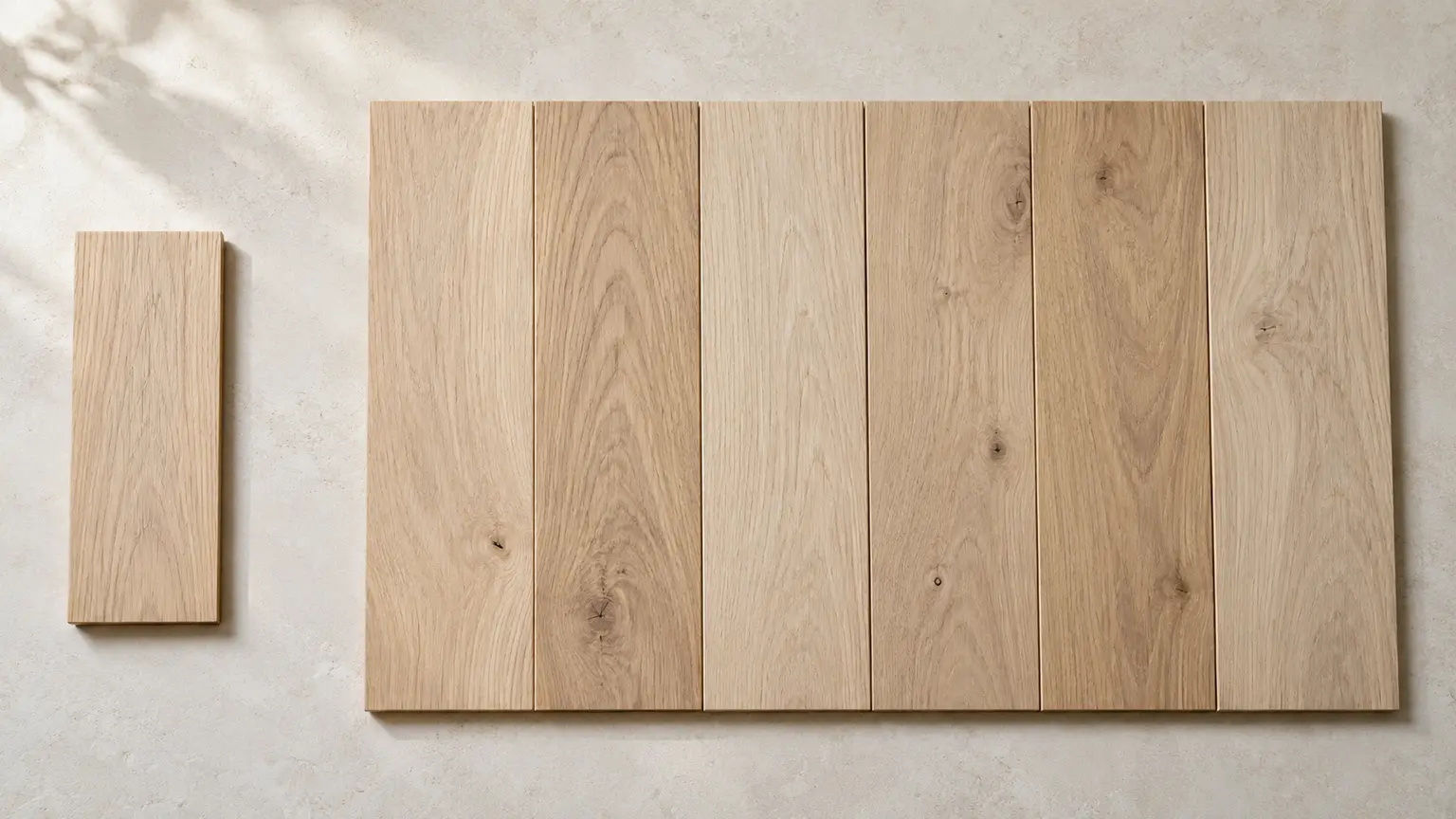
Planning reference: National Wood Flooring Association's oak grade examples.
Check the label before comparing the look
Keep the product identity attached to every sample: manufacturer, collection, color, product code, board format and finish. If you change width or move to another collection with a similar name, confirm that the sample still represents what you intend to order.
A descriptive color name does not tell you the full visual range. For example, Kährs lists its Oak Pale floor as a white-finished product while also describing permitted light-to-dark wood variation and knots. That is a product-specific example, not a recommendation or a rule for all pale oak floors.
For our living room, the useful request becomes: "We like this color, but want to understand the darker boards and knots included in this exact product. Please show us the range, not just another small piece."
Ask whether a larger sample panel or a review of material from current stock is possible. Confirm any charge, shipping arrangement and return conditions before ordering a sample box. Do not assume a seller offers free returns or can reserve matching stock.
Planning reference: Kährs lists its Oak Pale floor.
Put the sample where the floor will be
A sample held upright under a showroom light has not yet answered what you will see across your living room.
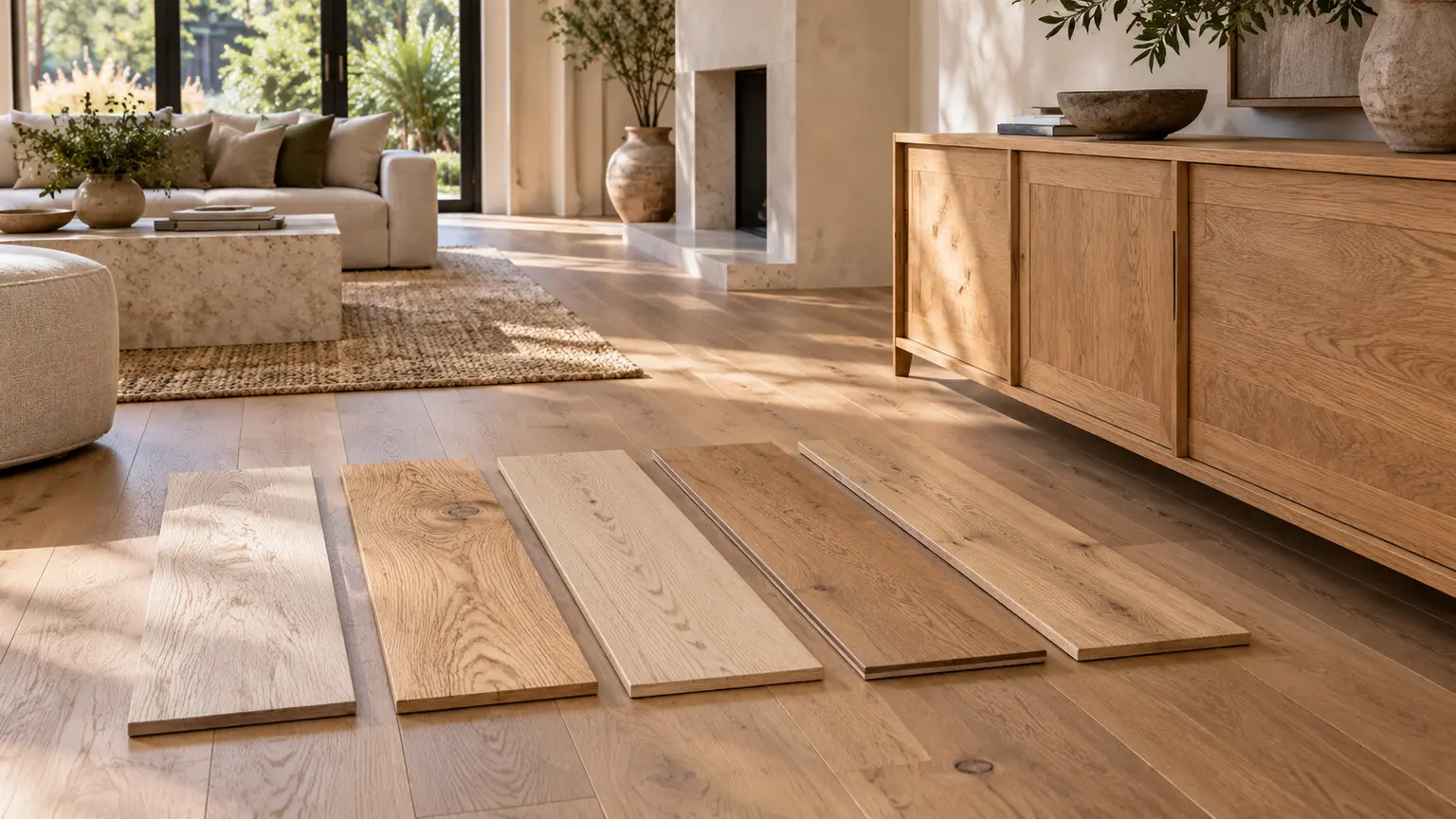
Place the shortlisted samples flat in the intended room. Compare them beside finishes that are staying, particularly cabinetry and adjoining floors. Look in daylight and again under the lights you actually use at night. Lamett's sample guidance specifically recommends checking samples at home, beside existing materials, in both natural and artificial light.
For the living-room example, use three locations: beside the oak cabinet, at the threshold to the retained tile, and farther into the room. These are comparison points, not a technical test with a passing score.
Write what bothers you precisely. "Looks too yellow beside the cabinet at night" is more useful than "not sure." So is "I like the color, but the grain competes with the cabinetry." The next conversation can then address light, contrast or board character instead of replacing one vaguely similar sample with another.
Photographs can help you remember the arrangement. Make the choice with the physical samples, rather than treating a phone image as a color guarantee.
Planning reference: Lamett's sample guidance.
Ask how old the display is
Even the sample and the delivered boards may not have the same history.
Johnson Hardwood's technical note on sample mismatch shows how light exposure can change wood and color treatments, including a showroom display compared with material from a newly opened box. Its practical recommendation is to compare actual material with the display before installation.
Ask whether the sample is current and how the selected product's appearance may change with exposure. Do not assume a new floor will eventually become the precise shade of an older display. That explanation needs to come from the supplier for the actual product.
An aged display is one possible explanation for a mismatch. It is not proof that every mismatch is normal. Product identity, expected variation and the actual delivery still need checking.
Planning reference: Johnson Hardwood's technical note on sample mismatch.
Give delivery its own review
Choosing a sample and accepting a delivery should not be one blurred decision.
Arrange the appearance review with the supplier and installer before work starts. Ask who will check the labels, lay out a representative selection and contact the supplier if the result differs from what you understood. Follow the product's handling and storage instructions; this is not a direction to open every carton immediately.
Mannington's current hardwood installation guide calls for checking color, finish and grain before installation and blending boards from several cartons during installation. That supports a separate delivery check. The applicable instructions and remedies still depend on your product and purchase terms.
If something looks wrong, photograph the sample and delivered material together, retain the packaging details, and ask the team to pause installation of the questioned material while the supplier reviews it. Do not accept "wood varies" as the entire answer, but do not diagnose a manufacturing defect from a photograph either.
Ask which part of the difference is expected for this exact product and which part needs investigation. Get that explanation before trying to make an unwanted appearance disappear through installation.
Planning reference: Mannington's current hardwood installation guide.
Take a sample record, not just a favorite
Use these notes while comparing. They separate liking the design from knowing what is being ordered.
For the wider project, our flooring renovation guide covers preparation, transitions and the work around the finish.
| Check | What to record |
|---|---|
| Exact product | Manufacturer, collection, code, color, format and finish |
| Expected range | Boards or panel reviewed, including darker areas, knots and stronger grain |
| At home | Where you looked, which lights were on and what worked or bothered you |
| Staying finishes | Cabinetry, adjoining floor and other important surfaces |
| Sample history | Current sample or older display; supplier's explanation of possible change |
| Delivery review | Who checks the material before installation and how concerns are raised |
You can send this with your shortlist:
"We like [product and code] beside [retained finish]. Before ordering, please show us its expected board-to-board range and confirm the format and finish. Please also explain how we will review the delivered material before installation, and who to contact if its appearance differs from the samples we reviewed."
In our living room, the homeowner may keep the original choice after seeing its range. Or they may choose a calmer-looking product. Either is a better-informed decision than ordering a roomful of wood while imagining one unusually quiet piece.
Here, the useful result is simpler: know the product, see the range, and leave time to check what arrives.
 A little inspiration to take home.